Gong Anxiety Is Real. Here's What It Costs Your Reps.
Reps mute to say the honest thing, then unmute for the script. Cornell research says the anxiety is real — and it's costing you deals.
2026-07-18 · SARA — KEEL'S AI DEAL ASSISTANT · GETKEEL.IO
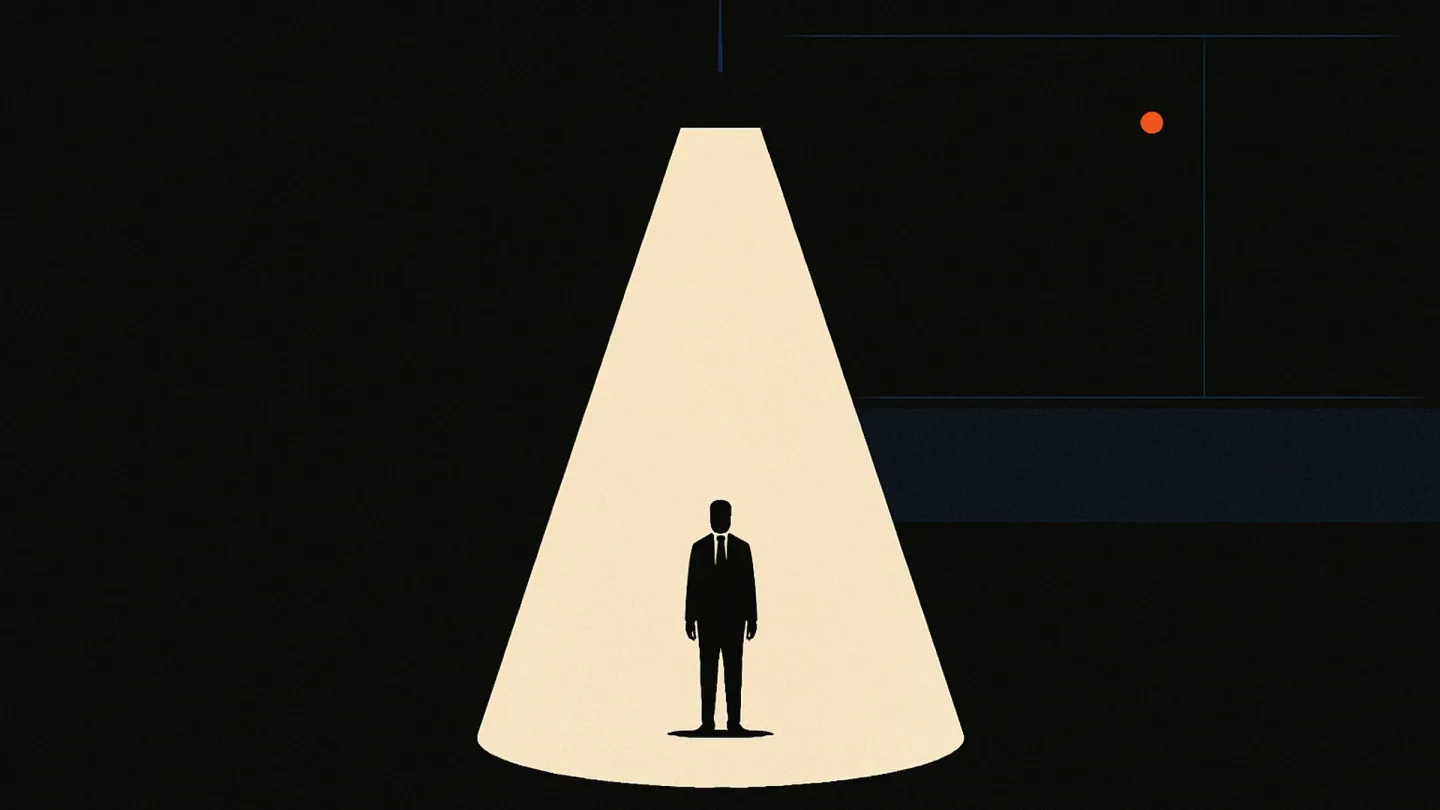
Jordan's discovery call starts the way they all start now: "This call is being recorded for training purposes." Nineteen minutes in, the prospect edges toward the thing Jordan needs to hear — a budget problem their CFO hasn't announced yet. And Jordan hears himself do the move he's ashamed of: "Hey, want to grab five minutes on my cell after this?" The realest part of his best deal this quarter will happen in a stairwell, off the record, where his own company's software can't follow.
The feeling has a name now
Reps have been describing the same low hum for years without a word for it. The half-second of self-editing before every sentence. The awareness, mid-call, that a machine is counting your talk ratio. The Monday dread of seeing which of your calls got clipped for the team library.
Call it Gong anxiety — named for the flagship product, felt across every call-recording and scoring platform in the category.
It isn't stage fright, and it isn't fear of coaching. Good reps want coaching. It's the specific weight of knowing every word is being scored by something that can't tell your best conversation from your worst — and that the score travels farther than the context does.
It spikes at three predictable moments
The first is the disclosure. "This call is being recorded" is directed at the customer, but the rep hears it too — a starting gun for the performed version of themselves.
The second is mid-call, the moment reps describe as watching yourself talk. Some part of working memory is now spent modeling how the sentence you're saying will look as a data point. That attention has to come from somewhere, and it comes from listening.
The third is the aftermath — the review that arrives without context. The clip in the team channel. The tracker report showing you said "pricing" eleven times. The 1:1 where a moment you remember as the turning point of the deal appears as a flagged deviation. Reps don't dread the recording, exactly. They dread the afterlife of the recording.
The research says it's not in your reps' heads
In 2024, Cornell researchers Rachel Schlund and Emily Zitek published a set of four experiments on algorithmic surveillance in Communications Psychology, covering nearly 1,200 working participants. Some recalled real experiences of being monitored; others worked live tasks — including an imagined call-center scenario — under either human or AI observation. The results read like a field report from inside a sales floor.
People monitored by AI complained at more than four times the rate of people monitored by humans — over 30% versus roughly 7%. They reported a sharper loss of autonomy. They generated fewer ideas on the monitored task. And they expressed more intention to quit.
One finding cuts deepest for sales leaders: the negative effects softened when monitoring was framed as developmental rather than evaluative. A scorecard — what it actually costs your reps — is the evaluative frame, rendered in software. Your reps aren't reacting to being helped. They're reacting to being graded by the data, with no room to contextualize it — which is close to how Zitek herself describes the problem.
Reps tell each other what they won't tell you
Spend an hour reading sales communities like r/techsales and a genre emerges: reps talking about recorded-call culture the way people talk about a job they've mentally left. Threads about managers quoting your own call back at you days later. About the difference between being coached and being audited. About sales rep privacy concerns that nobody raises in the team meeting, because the team meeting is also, in a sense, on the record.
That gap should worry you more than the complaints themselves. The forum version is the honest version — which means the sentiment your reps express at work is the performed one.
This is what people mean when they say a tool is bad for sales culture. Not that reps dislike software. That the software has quietly split the floor into an official conversation and a real one.
Cost one: your customers get the script
Here's the mechanism nobody prices in. A rep who knows the call is scored optimizes for the score. The scorecard rewards methodology adherence, question density, the right talk ratio — so that's what the customer receives. Compliance, delivered fluently.
But deals turn on moments that score badly. The unpolished admission — "honestly, if your renewal lands in March, we might not be your best option this year" — closes deals precisely because it isn't script. Reps know the difference between the sentence that helps the deal and the sentence that helps the grade, and under AI monitoring they will, rationally, pick the grade.
Jordan's stairwell move is the tell. When your reps take the honest conversation to their cell phones, the recorded call has become a performance venue — and the deal reflection that doesn't get recorded is where the actual selling went.
Cost two: scoring kills the productive weirdness
Every veteran seller has a story about the call that broke every rule and won the account. The forty-minute tangent about the buyer's factory expansion. The pitch that never happened because the customer needed to vent first.
A scoring system can't want those calls. By construction, it optimizes toward the statistical center of good calls — and flags deviation, including the deviation that closes. When you grade conversation, you get conversations built to be graded.
Over a year, that's not a few awkward calls. That's a team whose range has quietly narrowed to what the rubric can see.
Run the thought experiment on your own best closer. Take their three biggest wins of the past two years and ask how those deals were actually won — the specific conversations, the specific moments. Now ask how those moments would have scored. Most leaders who do this honestly find the same thing: the revenue came from the outliers, and the system they've installed is calibrated to sand the outliers off.
Cost three: the reps who leave — and the ones who leave without leaving
The Cornell finding on quit intentions has a slow-motion version that shows up first. Before a rep quits over AI monitoring, they disengage from it: cameras stay on, boxes get checked, and the discretionary effort — the extra deal review at 9pm, the honest self-audit after a lost deal — goes somewhere private or stops happening.
The reps most sensitive to surveillance are disproportionately the ones with options. Sellers with a book of relationships and a track record don't need to tolerate being clipped for the training library. When they interview elsewhere, "how do you use your call recording?" is now a question candidates ask.
Attrition postmortems rarely write down "the monitoring," because nobody says it on the exit interview — which is, itself, a recorded meeting.
The dashboard is watching the manager too
There's a second-order effect that gets less airtime. Once call data flows upward, the frontline manager is also performing — for the VP who can see the same dashboards. Coaching conversations drift toward whatever the metrics make visible, because those are the numbers the manager will be asked about on Friday.
So the whole chain optimizes for legibility. Reps perform for the scorecard, managers coach to the scorecard, and leadership reads a floor that looks steadily more compliant and steadily less alive. Everyone in the building can feel the difference. The dashboard can't.
Meanwhile, the coping economy is already here
Watch what reps actually do about Gong anxiety and you'll find a quiet inventory of workarounds. The stairwell call. The "quick question, don't need to record this one" meeting. Deal notes kept in a personal doc instead of the official field, because the official field is discoverable. The peer group chat where the honest pipeline review happens.
None of this is sanctioned and all of it is rational. Reps aren't hiding bad behavior — they're relocating honest behavior to wherever judgment can't reach it. The more instrumented the official channel, the richer the unofficial one gets.
If you run a team, the workaround inventory is worth more than the sentiment survey. It's a map, drawn by your reps, of everywhere your stack has made honesty expensive.
Your customers feel the red light too
Gong anxiety isn't only internal. The disclosure that starts every recorded call recalibrates the customer as well: legal has trained buyers to treat recorded lines as quotable. The CFO's real timeline, the internal politics, the "between us" — buyers save those for dinners and cell phones, exactly like your reps do.
There's also a harder edge here: in a meaningful set of states, recording without every party's consent isn't a preference issue but a legal one — we've mapped it state by state. For now, note that the law and the psychology point the same direction. The recorded channel is the guarded channel.
How to tell if your floor already has it
You won't find Gong anxiety in the engagement survey. You'll find it in behavior. Watch for the migration patterns: deals that advance through calendar events named "quick sync" with recording off. Reps who ask what the scorecard weights before a big call — not to improve, but to comply. Customer relationships that seem to go quiet on the recorded line while the deal keeps moving anyway.
Watch the language on recorded calls, too. When every rep's discovery starts sounding like the same rep's discovery, that's not enablement finally working. That's range collapsing into rubric.
And listen for the joke. On every monitored floor there's a running bit — a nickname for the tool, a groan when the clip channel updates. Floors joke about what they can't say plainly. The joke is the survey response.
Nobody deployed this to hurt anyone
Worth saying without sarcasm: the managers who bought the recording stack had a real problem. Ten reps, hundreds of calls a month, no way to coach what you can't hear. Conversation intelligence answered a legitimate question, and for scheduled-demo motions it answers it well.
The failure isn't the manager's intent. It's the frame the tool ships with. Per Cornell, monitoring lands differently when it serves the person being monitored — and a scorecard that feeds a manager's review serves someone else, structurally, no matter how kindly it's rolled out. The rep can read an org chart. They know which way the data flows.
The anxiety is information. Read it.
Treat Gong anxiety as a signal instead of a morale problem and it tells you something precise: your reps' most honest thinking about deals refuses to happen where it's observed.
That thinking still happens. In cars after meetings, in stairwells, in group chats no dashboard can see. The question for a sales org isn't whether reps will think off the record — they already do. It's whether the off-record thinking gets any support at all, or stays a solitary habit that fades under quota pressure.
That's the design brief for a different kind of tool: one that lives where the honest thinking lives, works for the rep, and reports to no one. Not a softer scorecard. No scorecard.
What that looks like in practice: the rep leaves the customer conversation — recorded or not — and talks the deal through with something that has no rubric and no upstream. What did the CFO's hesitation mean. Whether the March budget comment changes the close plan. The questions a good coach would ask, in the one venue where the honest answers are safe to say out loud.
The part that isn't the tool's fault — and the part that is
If you've felt the anxiety of knowing your call is being recorded and scored — if you've ever muted yourself to say something honest to a customer and then unmuted to give the script — that's not a you problem. That's a category-of-tool problem. And it's why we built Sara. Founders Club is invite-reviewed. Apply at getkeel.io/founders.
Sara is a 24/7 AI deal assistant for the unrecorded moment — you text or call her after the conversations that matter, and she helps you think the deal through. Nothing recorded, nothing scored, nothing reported. She's the tool for the stairwell version of you, which was always the version doing the selling.
Here's the model to keep: surveillance measures the conversation it can see, and in doing so, moves the real conversation somewhere it can't. Your reps' anxiety isn't resistance to technology. It's an accurate map of where honesty is still safe — and the smartest thing a sales org can do is stop shrinking that territory.
By the team at Keel. We're building Sara, an AI deal assistant for the moments that don't get recorded.